
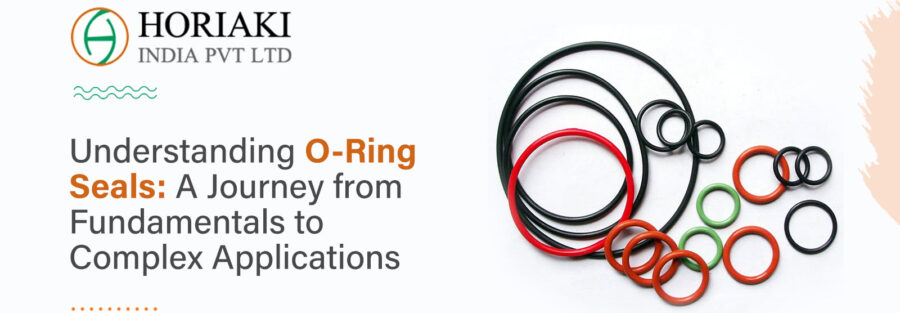
O-ring seals are extremely adaptable and commonly utilized as a sealing solution due to their efficiency, low cost, and ease of use in both static and dynamic applications. They are made from different elastomer materials that can seal almost any liquid or gas. Quality, quantity, application environment, cost-effectiveness, chemical and pressure compatibility, endurance, and lubrication needs are all important considerations when designing and manufacturing O-rings.
The versatility of O-ring seals!
O-rings are adaptable seals with a bidirectional, circular construction. They are commonly elastomeric but may also be made of PTFE or metal. They work by deforming their substance under installation and media pressure, sealing gaps between mating components.
However, these seals are not immune to problems. High system pressures can cause extrusion, in which the seal material deforms into the gap, resulting in seal failure. This problem can be solved by using tougher seal materials or adding backup rings for support.
An O-ring’s strength stems from its capacity to act as a highly viscous fluid under pressure, forming a positive barrier against the medium it is intended to seal. This distinguishing feature, along with its ability to return to its former shape upon deformation, makes O ring seals important in sealing applications.
Furthermore, because of its elastomeric structure, the O-ring can adjust to fluctuations in unit tolerance while remaining sealed. The squeeze, or degree of compression, is an important component in the design of O-ring seals. To compensate for wider groove dimension tolerances, O-rings with smaller cross sections require more squeezing.
How do O-ring seals work?
O ring seals are available in both pre-set standard sizes and bespoke sizes, and they both perform identically. These rubber, donut-shaped components function as gaskets, resulting in a more leak-free and safe seal between joints. These seals may be installed in either a groove or a channel, and they operate properly in both cases.
Applications for O-ring seals
There are several uses for O-rings in various sectors. Several of them include:
- In the gearbox and fuel systems.
- In the operation of medical equipment and gadgets like syringes and filters.
- In oil refineries and petrochemical industries, to prevent component contamination.
- In the manufacturing of electronic equipment to protect the insides from dust and water.
- To avoid water pollution in industries that produce drinking water.
- In the chemical industry, to avoid dangerous leaks.
- In pneumatic systems, to avoid fluid loss.
How are O-ring seals manufactured?
There are several procedures utilized to create O ring seals. Several of them include:
- Injection molding is the process of injecting molten rubber into a mold and allowing it to cool. Different elastomers can be molded to form O-rings.
- Transfer molding is identical to injection molding, except that external pressure is used to drive the molten material into the mold. As a result, the final O-ring seal is of higher quality and more precisely shaped and measured.
- A more conventional process in which the elastomer is forced through an aperture in the shape of the desired mold under external pressure. As a consequence, the elastomer conforms to the contour of the mold and produces the necessary dimensions.
- Pressure molding involves dividing the needed mold into two halves. The elastomer is injected into both mold parts, which are then bonded together under pressure and heat. This allows the elastomer to adopt the necessary form.
Conclusion
O-ring seals are probably one of the most widely utilized rubber components in a variety of sectors. When gases, air, liquids, or chemicals must be sealed, O ring seals are required in addition to conventional sealing techniques. These seals may appear to be small, basic components. However, if they do not meet the anticipated quality, they may create leaks, resulting in significant financial losses. Such leaks can occasionally endanger workers at the factory.
That is why you should only use O-ring seals from reliable suppliers such as Horaiki India. Our design and production teams collaborate to guarantee that criteria are met completely, and all items from our warehouse are tested many times to verify that they function properly. Contact us to learn more about the many varieties of O-rings we make.

Horiaki India Private Limited
Horiaki India Private Limited was established in the year 1998 with an aim to manufacture and supply premium rubber bonded products in India as well as the international market.