
Overview of Main Points
This guide explains how a maintenance team can identify the correct rubber metal gasket when a joint has to be resealed. It covers measuring the old gasket, matching size and pressure rating, choosing material and type, common errors and the details to share with a manufacturer.
Contents at a Glance
- Why the Correct Gasket Matters
- Reading the Old Gasket
- Measuring the Gasket
- Matching Size and Pressure Rating
- Checking Medium and Temperature
- Selecting Type and Rubber Material
- Common Identification Errors
- Fitting, Storage and Inspection
- Questions to Ask Your Manufacturer
- Requesting a Recommendation
- Frequently Asked Questions
Why the Correct Gasket Matters
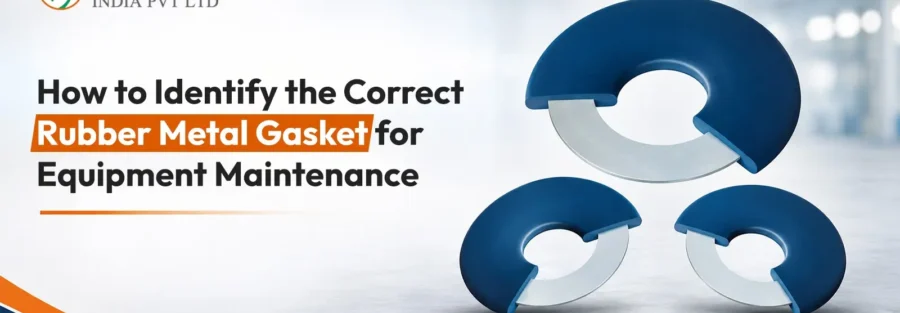
Rubber metal gaskets are flange gaskets made of rubber with a steel ring vulcanised inside. They seal water and similar media between two pipe flanges.
During maintenance, a joint is often opened and the gasket must be replaced at once. A wrong gasket means leakage and a second shutdown, which costs far more than the gasket itself.
For this reason, the gasket should be identified correctly before it is ordered or fitted.
Reading the Old Gasket
Examine the old gasket before it is discarded.
- Check markings. Note any size, type or material marking on the gasket or its packing.
- Look at the condition. Hardening, cracking or swelling shows how the rubber behaved.
- Note the colour. The standard gasket is black.
- Record the line. Note the flange, equipment and medium.
- Keep a sample. Keep a damaged gasket or a photograph for the manufacturer.
A swollen or sticky gasket usually points to a medium that the rubber cannot resist, such as oil. This should be reported to the supplier, since simply fitting the same gasket again will repeat the failure.
Measuring the Gasket
Every rubber metal gasket is defined by three dimensions:
- d1, the inner diameter
- d2, the outer diameter
- s, the thickness
Use a vernier calliper and measure at more than one point on the gasket. An old gasket is compressed, so its thickness will read lower than the original. Rely on the standard thickness for the nominal size, and use the measured value only as a cross-check.
The outer diameter is important because it fits the inner bolt circle of the flange. This makes the gasket self-centering, so it sits correctly without extra adjustment.
Matching Size and Pressure Rating
The gasket must also match the nominal size (DN) and pressure rating (PN) of the flange. Horiaki India Pvt. Ltd. lists dimensions as per DIN EN 1514-1 for PN 6 to PN 40 and sizes from DN 15 up to DN 2000.
The outer diameter changes with the pressure rating. Examples (mm):
- DN 50: thickness 4, d1 61. The d2 is 96 at PN 6 and 107 at PN 10, 16, 25 and 40.
- DN 100: thickness 5, d1 115. The d2 is 152 at PN 6, 162 at PN 10 and 16, and 168 at PN 25 and 40.
- DN 200: thickness 6, d1 220. The d2 is 262 at PN 6, 273 at PN 10 and 16, 284 at PN 25 and 290 at PN 40.
Some size and pressure combinations are not listed, so confirm yours before ordering.
If the flange is not to the DIN standard, share the flange drawing or bolt circle diameter.
Selecting Type and Rubber Material
Horiaki lists several rubber metal gasket types, including KTW, W270, DGVW and water line gaskets. All are built with an inside vulcanised steel ring, a lens-shaped cross section with rounded edges, and self-centering outer diameter. If your old gasket carries a type name, note it down. If it does not, describe the application to the manufacturer and ask which type applies.
Standard gaskets use natural rubber (SMR). EPDM, FKM and silicone are also listed. Hardness is Shore A 60 to 80, ±5 (DIN 53505), and density is 1.384 g/cm³ (DIN 53479).
Do not assume that a gasket of the same size can be fitted in any line. The material has to suit the medium.
Checking Medium and Temperature
For natural rubber, the manufacturer states:
- Resistant to: water, seawater, pond water and closed loop water up to 90°C.
- Partly resistant to: alkalines, such as 50% NaOH at 50°C.
- Resistant to: natural light, weather and ozone.
- Not resistant to: fuel, mineral oils, acids and gases.
The working temperature is approximately 80°C, and up to 90°C for short periods.
Before reordering, confirm the medium, concentration and temperature in the line, since the process may have changed. Oil, acid or gas lines need a different compound.
Common Identification Errors
Most wrong orders come from a few repeated mistakes.
- Matching by inner diameter only. The outer diameter and pressure rating must also match.
- Copying a compressed gasket. Its measured thickness is not the original.
- Ignoring the medium. Natural rubber swells or hardens on oil, acid or gas lines.
- Assuming the old gasket was correct. If it failed early, check the cause before repeating the choice.
- Mixing up DN and PN. Flanges of the same DN may need gaskets of different outer diameter.
Fitting, Storage and Inspection
Horiaki notes that gasket life depends largely on proper storage and fitting, and asks users to follow its installation instructions.
- Clean both flange faces and check them for scratches or pitting.
- Fit the gasket centred inside the bolt circle.
- Tighten the bolts gradually and in a cross pattern.
- Use a fresh gasket at each joint, and do not reuse a compressed one.
Store spares in a cool, dry place, away from sunlight and heat. Inspect the joint for seepage at start-up and regularly, and record the gasket type, size and date of fitting for each critical line.
Questions to Ask Your Manufacturer
Put these questions to the supplier before ordering:
- Which gasket type matches my old gasket and application?
- Which rubber compound and hardness are used?
- What are the medium and temperature limits?
- Do the dimensions follow DIN EN 1514-1 for my DN and PN?
- Can a customised size be made for a non-standard flange?
- What are the delivery time and installation guidelines?
Clear answers to these will confirm that the gasket is the right one.
Requesting a Recommendation
Collect the old gasket or a photograph, measured d1, d2 and thickness, flange DN and PN, medium, operating temperature and quantity. For non-DIN flanges, add a drawing.
Horiaki India Pvt. Ltd, based in Chennai and operating since 1998, manufactures rubber metal gaskets along with valve seals, O-rings, anti-vibration mounts and other rubber products. The range can be seen at horiaki.co.in/rubber-metal-gaskets. Maintenance teams are welcome to share their details with the team and ask for a suitable recommendation. A short check at the start avoids a wrong order and a repeated shutdown.
Frequently Asked Questions
What is the steel ring inside the gasket for?
The vulcanised steel ring takes the force of the flange bolts, so the rubber is not over-compressed. It also helps the gasket stay in position.
Can I identify a gasket from its inner diameter alone?
No. The outer diameter, thickness and pressure rating must also match the flange. Share all three dimensions along with the DN and PN.
Can the same gasket be used on an oil or acid line?
Natural rubber gaskets are not resistant to fuel, mineral oils, acids and gases. For such media, a different compound must be selected after consulting the manufacturer.
What temperature can the gaskets withstand?
The working temperature is about 80°C, with short-term exposure up to 90°C. Operation above this range needs a different material.