
Quick Summary
Vibration quietly damages machines. It loosens bolts, wears out bearings, cracks welds and shortens equipment life. Anti vibration mounts sit between a machine and its base to absorb shocks and reduce vibration.. Good quality mounts use better rubber, stronger bonding and accurate load ratings, so they keep working for years. Premium mounts protect bearings, motors, welds and nearby equipment from early wear, and they also cut noise. This guide explains how good mounts protect machinery and how to choose them.Table of Contents
What Are Anti Vibration Mounts?
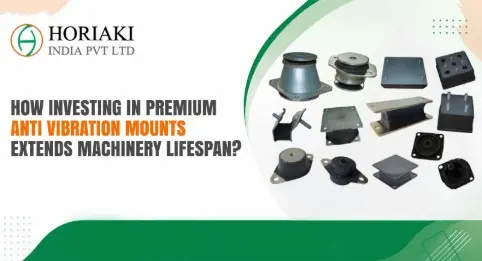
Anti vibration mounts are supports placed under or around a machine to reduce the vibration that passes into the floor, the frame or other equipment. Most have a rubber or elastomer part bonded to metal plates, though some designs use steel springs or air cushions.
You may also hear them called vibration isolation mounts, because their job is to isolate the machine from its surroundings. The idea is simple. The mount gives a little, absorbs the movement and keeps most of it from travelling onward.
A machine bolted rigidly to a floor sends every shake straight into the structure. The same machine on well-chosen mounts runs quieter and puts far less stress on itself and its base.
How Does Vibration Damage Machinery?
Most plants live with some vibration and treat it as normal. The damage is slow, so it is easy to ignore, but it adds up.
- Loose fasteners: bolts and nuts work loose and need frequent tightening.
- Bearing wear: constant shaking shortens bearing life.
- Fatigue cracks: welds, brackets and frames crack after repeated stress.
- Misalignment: shafts, belts and couplings drift out of line.
- Noise: vibration travels through the structure and becomes noise.
- Damage to nearby equipment: instruments and sensitive machines suffer.
- Operator fatigue: people working near shaking machines tire faster.
- Unplanned downtime: small failures turn into stoppages.
Each item looks minor alone, but together they raise repair cost and reduce machine life.
How Good Anti Vibration Mounts Extend Machinery Life
A good mount does not remove vibration completely. It reduces it enough to change how the machine ages.
- Lower stress on parts: less shaking means less load on bearings, shafts and frames.
- Fewer loose bolts: maintenance teams spend less time retightening.
- Better alignment: couplings, belts and gears stay in position for longer.
- Protection of the foundation: the floor and the building structure take less force.
- Reduced noise: a quieter workplace, with less structure-borne sound.
- Smoother operation: better product quality in machines that need steady movement.
- Lower maintenance cost: fewer breakdowns and longer service intervals.
The result is a machine that works longer between repairs, and a plant that plans its maintenance instead of reacting to failures.
Premium vs Low-Cost Anti Vibration Mounts
Two mounts can look the same on the shelf and behave very differently after a year. Here is what separates them.
- Rubber quality: premium mounts use well-formulated compounds that stay flexible, resist aging and cope with heat, oil and ozone. Cheap rubber hardens and cracks.
- Bonding strength: a strong rubber-to-metal bond prevents the rubber from tearing away from the plate.
- Accurate load rating: the stated capacity matches real performance, so the mount works in its correct range.
- Resistance to permanent set: a good mount returns to shape, while a poor one sags under constant load.
- Metal parts: plated or coated steel resists rust.
- Consistency: every piece in the batch behaves the same, which keeps a machine level and balanced.
- Test data: premium suppliers can share hardness, load and deflection details.
The cost difference at purchase is usually small compared with the cost of one unplanned stoppage. That is why premium mounts are better seen as an investment.
Types of Anti Vibration Mounts
The right type depends on the machine and the kind of vibration.
- Rubber-to-metal mounts: the most common type. They suit motors, pumps, compressors and general machinery.
- Cylindrical (bobbin) mounts: compact, and used in engines and light equipment.
- Conical and bell mounts: handle loads from several directions, and suit engines and generators.
- Levelling mounts: have an adjustable foot for machine tools and production equipment.
- Spring mounts: use steel springs for heavy loads and low-frequency vibration.
- Air mounts: give very soft support for sensitive equipment.
- Pads and sheets: simple layers of rubber or similar material under light machines.
Some vibration control mounts also include a limit stop, which prevents too much movement during shock or start-up.
Where Anti Vibration Mounts Are Used
- Generators and DG sets: reduce engine vibration and noise.
- Compressors and pumps: protect the base and the pipework.
- Electric motors and fans: smooth running and quieter operation.
- HVAC equipment: chillers, air handling units and blowers.
- CNC and machine tools: keep precision and surface finish.
- Presses and packaging machines: absorb repeated impact.
- Vehicles and construction equipment: isolate engines and cabins.
- Laboratory and electronic equipment: protect sensitive instruments.
How to Choose the Right Mount
Good selection follows a simple method.
- Find the load per mount. Divide the machine weight by the number of mounts, and consider where the centre of gravity lies, since the load is rarely equal at each corner.
- Find the disturbing frequency. For a rotating machine, divide the speed in rpm by 60 to get the frequency in Hz. A machine running at 1,500 rpm vibrates at 25 Hz.
- Avoid resonance. If the two frequencies are close, vibration gets stronger, not weaker.
- Check the environment. Heat, oil, chemicals, moisture and sunlight all affect the choice of rubber.
- Consider shocks and movement. Choose a mount with limit stops if the machine moves or takes shocks.
- Choose the mounting style. Stud, bolt-down or levelling type, depending on the base.
- Ask for data. Request load and deflection charts, and test details.
If you are unsure, give the mount supplier the machine weight, speed, size and operating conditions, and ask for a recommendation.
Conclusion
Anti vibration mounts are a small part of an installation, but they protect some of its most expensive assets. Premium mounts reduce wear, cut noise, prevent loosening and keep machines accurate for longer. Choosing the right type, load rating and material at the start is far cheaper than repairing the damage that vibration causes later. If you need premium quality mounts in standard or customised sizes, you need to source them from reliable anti vibration mount manufacturers like Horaiki India.
Frequently Asked Questions
What are anti vibration mounts used for?
They reduce the vibration that passes from a machine into its base, which protects the machine, the structure and the people nearby.
How do anti vibration mounts work?
The flexible part of the mount, usually rubber or a spring, absorbs the movement from the machine. This reduces the force that reaches the floor or frame.
How do I choose the right anti vibration mount?
Calculate the load per mount and the machine’s operating frequency, and choose a deflection that gives good isolation. Also check the environment and the mounting style.
What is the difference between rubber and spring mounts?
Rubber mounts suit most general machines and also absorb some high-frequency noise. Spring mounts suit heavy loads and low-frequency vibration.
How long do anti vibration mounts last?
Life depends on the rubber quality, load, temperature and exposure to oil or chemicals. Check them regularly, and replace them if they crack, harden or sag.
Can anti vibration mounts reduce noise?
Yes. By stopping vibration from travelling into the structure, they reduce the noise that the floor and walls would otherwise radiate.