
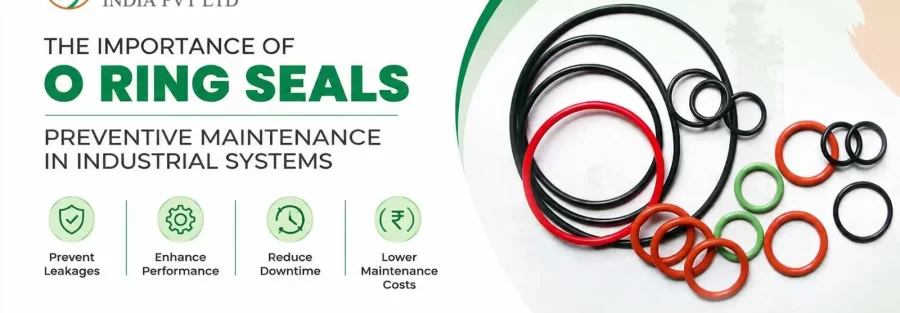
Here’s something most people in industrial maintenance already know but rarely talk about: some of the most expensive equipment failures trace back to a rubber ring the size of a coin. O ring Seals are everywhere in industrial systems. Inside your hydraulic cylinders, across your pneumatic fittings, around your pump shafts, inside your valves. You don’t notice them until something leaks, a line goes down, or a shutdown gets called that nobody planned for.
The frustrating part? Most of those failures were coming; there were signs, like the seal was hardening, or the fluid had changed, and nobody updated the material spec. But because O ring seals don’t come with warning lights, they get ignored until there’s a problem. A 2019 report from the Fluid Sealing Association found that improper maintenance and installation together account for more than 60% of all elastomeric seal failures in industrial settings. That’s not a material quality problem. That’s a maintenance problem, and it’s fixable.
This article breaks down exactly what good preventive maintenance looks like, why it matters, and how to build a routine that actually keeps your systems running.
Understand What You’re Actually Maintaining
O ring seals work on a simple principle. You squeeze them into a groove, and the compression creates a tight barrier that stops fluid or gas from passing through. This is a simple concept, but the execution gets complicated fast.
The seal’s material, hardness, size, and groove dimensions all have to be matched to the specific requirement. A seal running in a hydraulic press sees very different conditions than one in the static inside a valve that rarely moves. Same shape, completely different demands.
Here’s where most people lose the thread: they treat all O ring seals as interchangeable. They grab whatever’s in the parts bin, install it, and move on. And when it doesn’t, the failure usually comes at the worst possible time.
These seals show up across nearly every industry you can name:
- Oil and gas pipelines and wellhead equipment
- Automotive engines, brakes, and fuel systems
- Aerospace hydraulic and fuel systems
- Food processing lines where FDA compliance is non-negotiable
- Pharmaceutical mixing and transfer equipment
The conditions across those industries vary enormously. The maintenance approach should too.
What Actually Degrades an O Ring Seal?
You can’t maintain something well if you don’t understand what breaks it down. For O ring seals, there are four main things, and in many systems, you’re dealing with more than one at the same time. The things that can spoil the ring seals are:
- The Wrong Material for the Work: Every elastomer has a compatibility profile. Nitrile (NBR) handles petroleum oils well but breaks down around ozone and ketones. Viton (FKM) resists heat and aggressive chemicals but costs more. Silicone performs across wide temperature ranges but has poor mechanical strength. EPDM handles steam and hot water well, but swells badly in oil.
Put the wrong material in the wrong environment, and you’re not maintaining a seal; you’re just delaying a failure. Butyl rubber, for instance, holds up fine against boric acid, but put it near diesel oil and it deteriorates quickly. These aren’t edge cases. They happen when process fluids change, and nobody updates the seal spec. - Heat and Cold Both Do Damage: Most maintenance teams think about heat. High temperatures cause rubber to harden, lose flexibility, and eventually crack. What gets overlooked is the cold side. When a seal gets too cold, it shrinks. That tiny gap it creates is enough for fluid to sneak past.
What’s actually trickier than either extreme is temperature cycling, systems that heat up during operation and cool down overnight or between shifts. That repeated expansion and contraction puts stress on the rubber in a way that constant high heat sometimes doesn’t. Seals in those applications wear out faster and need more frequent checks. - Pressure Forcing the Seal Out of Position: Under high enough pressure, an O ring seals start to squeeze into the gap between the two surfaces it’s sealing. Engineers call this extrusion. Once it starts, the seal edge gets shredded a little bit with every pressure spike, and failure follows not too far behind.
Backup rings are designed to stop extrusion by blocking that gap. But backup rings wear out, too. If they’re not checked during maintenance, you end up with false confidence, a system that looks like it’s protected but isn’t.
Lubrication is one of the most overlooked parts of O ring seal maintenance. And it’s not just about applying any lubricant; it has to be the right one. Use a lubricant that’s incompatible with the seal material, and you’ll cause swelling or softening that’s arguably worse than no lubricant at all.
Building a Maintenance Routine That Works
A lot of companies have a maintenance schedule on paper that doesn’t reflect what actually happens on the floor. The goal here is something practical, a routine you can actually follow.
Regular Physical Inspections
How often depends on the application. High-pressure systems need monthly checks. Less demanding setups can go quarterly. Anything that’s been running in unusual conditions, temperature spikes, chemistry changes, or extended hours should jump the queue.
During each inspection, you’re looking for a handful of specific things:
- Cracks, cuts, or flat spots on the seal surface
- A compression set occurs when the seal has permanently flattened and lost its springback. Press it gently; if it doesn’t recover, it’s past its useful life
- Swelling or discoloration, which points to a chemical compatibility problem
- Extrusion at the seal edges
- Uneven wear, which can indicate misalignment or incorrect groove dimensions
A logbook that tracks what you found and when is how you catch patterns; a seal that needs early replacement three cycles in a row is telling you something about that specific application.
Installation Mistakes That Cause Early Failures
This section is for anyone who’s ever installed a fresh seal and had it fail within a short cycle. Most of the time, the seal wasn’t defective; the installation was. Common mistakes that shorten seal life dramatically:
- Overstretching during installation. Never stretch an O ring seal beyond 50% of its original inside diameter. Once stretched past that point, the cross-section thins, and the seal never returns to its intended shape.
- Using screwdrivers, picks, or other sharp tools to seat the seal. Even a small nick on the seal surface becomes a leak path under pressure.
- Installing a twisted or pinched seal without noticing. It looks seated, but it isn’t, not correctly.
Slow down during installation. Check that the seal is seated correctly before reassembly. It takes three extra minutes, and it’s worth it every time.
Storing Your Seals the Right Way
Seals that degrade on the shelf before they ever get installed are a waste of money and a hidden maintenance problem. Rubber doesn’t store well under bad conditions. Components for Effective Sealing are:
- Keep your O ring Seals away from ozone, and ozone sources aren’t just outside air. Electric motors, fluorescent lights, and some welding equipment all generate ozone. Store seals in a different area from those sources.
- Direct sunlight is also a problem. UV exposure accelerates rubber aging, so keep seals in a closed container or cabinet.
- The temperature for storage should stay below 25°C if possible. Don’t store seals near heat sources, and don’t leave them in vehicles or outdoor sheds where temperatures swing.
Most elastomers have a shelf life of 5 to 10 years if stored correctly. Follow a first-in, first-out system with your inventory. Older stock gets used first.
Conclusion
Regular preventive maintenance of O ring seals is not something you schedule when things go wrong; it is what keeps things from going wrong in the first place. A small seal doing a small job can bring an entire system to a halt when it fails. Staying ahead of that with routine inspection and timely replacement is just good engineering practice. Horiaki has been helping industrial teams do exactly that, keeping systems sealed, efficient, and running without interruption.
FAQ’s
It really depends on what the system is doing. High-pressure hydraulic systems and anything running in elevated temperatures should be checked monthly. Quieter, lower-stress applications can usually be covered with a quarterly inspection. If your process fluids or operating conditions have changed recently, that’s a reason to bump up the frequency regardless of what the schedule says.
A few things to check: visible cracking or cuts on the surface, any swelling or color change that wasn’t there before, a flat profile where the seal used to be round (that’s compression set), or visible material that’s squeezed out past the groove edge. Any of those are signs the seal needs to come out.
More than most people realise. The wrong lubricant can cause the rubber to swell or soften, which accelerates failure. Always cross-check the lubricant against the seal material; this information is usually available from the seal manufacturer. If you’re unsure, ask. It’s a quick check that prevents a common problem.
Most elastomers will last 5 to 10 years in storage if conditions are right, cool temperature (below 25°C), away from light, ozone, and electrical equipment, stored flat or loosely hung. The specific shelf life varies by material. Nitrile and EPDM tend to age faster than Viton. Always check the manufacturer’s guidance for the material you’re using, and rotate your stock so older inventory gets used first.