
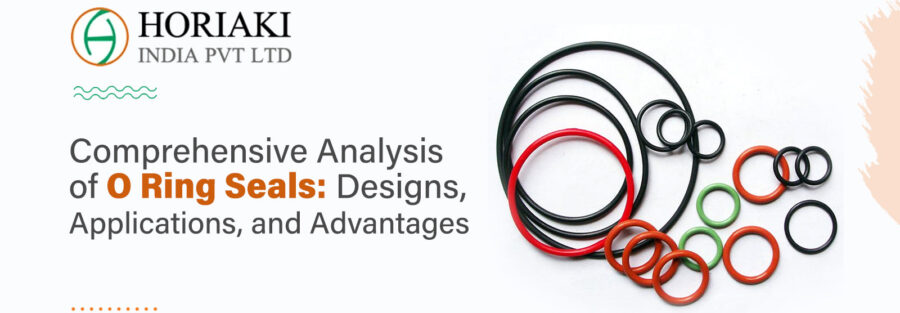
Rubber O Ring Seals are round, doughnut-shaped components that fit into grooves and provide seals between two sections. These O Ring Seals, made of a variety of rubber compounds, are exact and meet the requirements of the application. This makes them suitable for both dynamic and static sealing applications. They maintain a seal between two non-moving components in static applications and prevent leaks in moving elements like hydraulic cylinders in dynamic conditions.
Components of O Ring Seals are vital in systems requiring airtight or fluid-tight seals due to their flexibility and durability. Their major duty is to protect gases and liquids from leaking and to keep out external pollutants. This makes them critical in automotive, plumbing, and industrial machinery applications, where even slight leaks can result in expensive failures.
As the demand for high-performance seals increases, rubber compound manufacturers are developing materials that are more resistant to extreme temperatures, pressures, and chemicals.
Design and Construction of O Ring Seals
The O Ring Seals has been around since the beginning of the twentieth century. Surprisingly, the overall design of the O Ring Seals has stayed the same, despite the material change. However, in their simplest form, they are exceedingly clear and dependable.
O Ring Seals are one-piece molded elastomeric rings with a circular cross-section. O Ring Seals are defined by their size (inner diameter and cross-section, or breadth), substance, and hardness. The gland compresses and holds the O Ring Seals. The O Ring Seals seal is made up of these two elements: an O Ring Seals and a gland.
They get their name from their shape and are designed to provide a leak-proof barrier between two components, preventing gases or liquids from escaping. Essentially, they are a type of gasket, but they are employed in high-pressure settings. They sit in a groove or channel between two surfaces, which are then forced together. The more pressure applied to the joint, the more deformed the O Ring Seals get, enhancing the seal to a certain extent.
How to use O Ring Seals
These are frequently found in pumps, valves, connections, and cylinders. The seal connects two independent components. These components might be static, dynamic, hydraulic, or pneumatic; therefore, O Ring Seals offer a versatile option. Even after compression pressures are reduced, the O Ring Seals will return to their original form, but it will eventually need to be replaced.
Advantages of O Ring Seals
- They seal throughout a wide range of pressure, temperature, and tolerance.
- Tightening does not produce critical torque; therefore, structural damage is unlikely.
- In many circumstances, an O Ring Seals may be reused, giving it an advantage over non-elastic gaskets and crush-type seals.
- The life expectancy of the O Ring Seals material corresponds to its usual aging time when used correctly.
- Where varying degrees of compression affect seal effectiveness (as with flexible gaskets), an O Ring Seals is unaffected since metal-to-metal contact is normally permitted.
- O Ring Seals often occupy relatively little space and are lightweight.
- O Ring Seals failure is often gradual and clearly identifiable.
- Easy to use, no smearing or retightening.
- They are cost-effective.
Conclusion
If you are searching for O Ring Seals at affordable prices, contact Horaiki India Pvt. Ltd. Our team can make customized O Ring Seals according to your specifications. Request a free quote now.

Horiaki India Private Limited
Horiaki India Private Limited was established in the year 1998 with an aim to manufacture and supply premium rubber bonded products in India as well as the international market.