
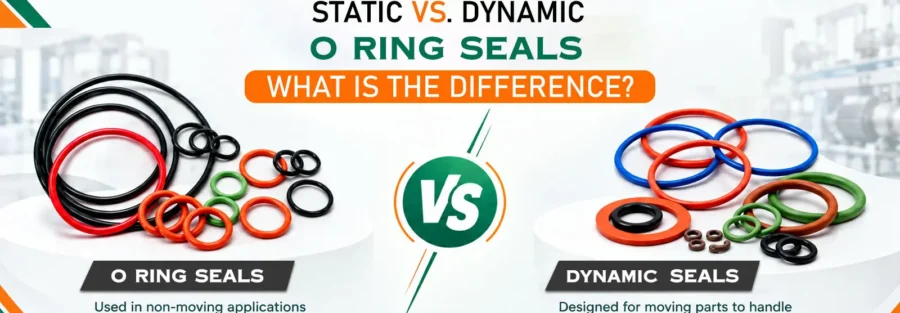
Overview – Choosing between static and dynamic O Ring Seals comes down to one basic question: do the two surfaces the seal sits between move relative to each other, or do they stay put? Both types do the same core job, blocking fluid or gas from escaping a joint, but the movement involved changes what the seal has to withstand and which material and design suit it best. Getting this wrong shows up as a leak, a seal that wears out fast under motion it was never meant to handle, or, on the other side, paying for a heavier-duty seal than a simple static joint ever needed.
This blog covers:
Introduction
O Ring Seals look identical sitting in a box, a simple ring of rubber or elastomer, but where and how that ring is installed changes everything about how it performs. A seal fitted between two parts that never move relative to each other faces sustained pressure and holds a fixed compression, while one fitted where a rod, piston, or shaft is constantly sliding or rotating against it faces friction, heat, and surface wear on top of that pressure. Confusing the two, or assuming any O ring seal works anywhere, tends to end in leaks, premature wear, or a seal that fails well before it should.What Makes a Seal Static or Dynamic
The distinction comes down to relative movement between the two surfaces the seal sits between.A static O ring seal is fitted between two non-moving parts, such as a flange joint or a pipe connection bolted together and left in place. Once installed, the O Ring Seals in this kind of joint are not expected to move at all; they simply stay compressed in the groove and hold the seal for as long as the joint remains assembled.
A dynamic O ring seal, on the other hand, is fitted where one part moves against the other, such as a piston moving inside a cylinder or a rotating shaft passing through a housing. Here, the O Ring Seals face continuous rubbing, called gland movement, against the surface they are sealing, which introduces friction and wear that a static application never has to deal with.
Groove Design and Compression Differences
Because the demands are different, the groove and compression specifications for each type are not identical either.Static O Ring Seals are generally compressed more, often between 15% and 30% of the ring’s cross-section, since there is no relative motion to worry about, and a firmer compression gives a more reliable long-term seal. Dynamic O Ring Seals use lighter compression, typically between 10% and 20%, because too much compression against a moving surface increases friction, generates heat, and accelerates wear on both the seal and the surface it moves against.
Groove finish matters more for dynamic applications as well. A rougher surface finish on a static joint rarely causes a problem, but the same roughness on a dynamic surface will abrade the O Ring Seals with every stroke or rotation, cutting the seal’s working life short enough that it needs replacing far sooner than a static seal in similar conditions.
Material and Wear Considerations
Material choice often follows directly from whether the application is static or dynamic.For static applications, material selection usually centers on chemical compatibility and temperature resistance, since the seal is not fighting friction. Nitrile rubber, EPDM, and fluorocarbon compounds are common choices depending on what fluid or gas the joint is sealing and the operating temperature involved.
For dynamic applications, wear resistance and low friction matter just as much as chemical compatibility, sometimes even more. Materials with better resistance to abrasion, sometimes paired with a bit of lubricant or a low-friction coating, are picked so the seal can take the constant sliding or rotating without wearing out too soon. This is also the reason dynamic seals get checked and changed more often than static ones in most maintenance schedules, simply because the ongoing movement wears them down faster.
Which Applications Suit Each Type?
Static O Ring Seals are mostly used at places where two parts are bolted together and stay that way for years, so the ring just has to sit tight in one spot and hold the seal.Static O Ring Seal Suit:
- Flange joints and pipe fittings that remain closed and are hardly ever opened
- Pump and valve covers that stay fixed in one place
- Sight glasses and access covers, where nothing around the seal really moves
- Any spot where the job of the seal is simply to hold pressure and stay put
Dynamic O Ring Seal Suit:
- Cylinders in hydraulic and pneumatic systems, where the piston keeps sliding in and out
- Shafts that keep rotating, such as in pumps, motors, and gearboxes
- Rods that go back and forth again and again, like in reciprocating machines
- Any place where the seal has to keep working properly even though the parts around it never stop moving
Where Horiaki India Private Limited Fits Into This
Horiaki India Private Limited makes O Ring Seals in materials such as nitrile rubber, fluorocarbon, silicone, and EPDM, suited for both static and dynamic use across a wide range of industries. As one of the well known O Ring Seals Manufacturers in India, based out of Chennai, Tamil Nadu, the team also customizes the design, material, and size as per what your application actually needs, instead of pushing the same seal for everything.Frequently Asked Questions
Can the same O ring seals be used for both static and dynamic applications?
Technically the same ring can sometimes physically fit both, but using a seal designed for static duty in a dynamic application usually leads to faster wear, since it was not built to handle continuous friction. It is best to select the seal type based on the actual movement involved rather than assuming one design works everywhere.
How often should dynamic O Ring Seals be replaced compared to static ones?
Dynamic seals generally need more frequent inspection and replacement because ongoing motion wears them down faster, while static O Ring Seals in a properly compressed, undisturbed joint can often last for years without needing attention.
Does compression percentage really make a noticeable difference in seal performance?
Yes, compression that is too high in a dynamic application increases friction and heat, shortening the seal’s life, while compression that is too low in a static application risks an unreliable seal that may leak under pressure changes.
What is the most common cause of a dynamic O ring seal failing early?
Excessive friction from over-compression, a rough or damaged surface finish on the moving part, or an unsuitable material for the wear involved are the most common reasons a dynamic seal fails sooner than expected.